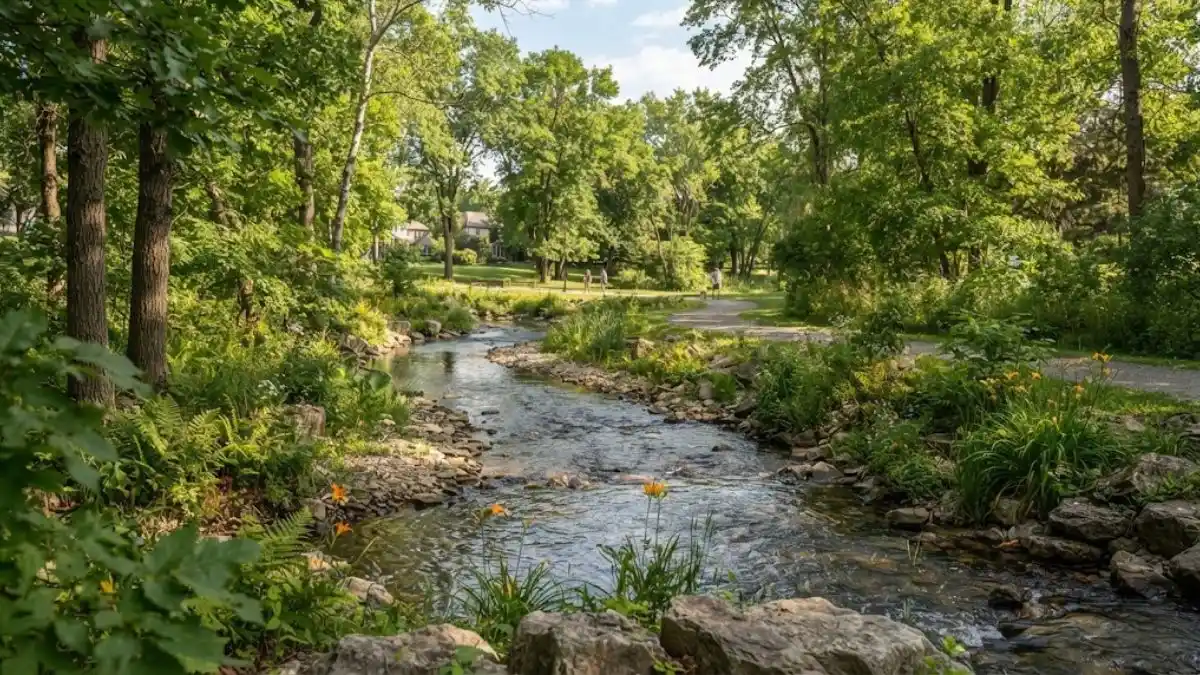
Cherry Creek and its tributary Sulphur Gulch run through Parker, and during the town's heaviest storms, both can carry more water than the surrounding stormwater infrastructure was originally designed to handle.
Cherry Creek and its tributary Sulphur Gulch run through Parker, and during the town's heaviest storms, both can carry more water than the surrounding stormwater infrastructure was originally designed to handle.
Cherry Creek has shaped this part of Douglas County long before Parker existed as a town, historically serving as a natural travel corridor, part of why the Cherokee Trail and later the Denver-Santa Fe Stage Road followed a path near it. Sulphur Gulch developed as a natural drainage tributary feeding into the larger creek system, and both waterways now run through a mix of open space and developed neighborhoods.
Parker's rapid development from the 1990s through the 2010s left some older subdivisions with drainage systems that predate current stormwater standards. That produces localized flooding in specific neighborhoods during heavy rain rather than a single, uniform citywide flood pattern.
Afternoon summer thunderstorms tied to the Palmer Divide hail corridor can drop flash-flood levels of rain in a short window, more than gradual, all-day rain would. That intensity is what overwhelms channels like Sulphur Gulch faster than a slower, steadier storm would.
Homes sitting at a lower point relative to the surrounding grade, particularly those near the natural drainage path of Cherry Creek or Sulphur Gulch, receive runoff from a wider surrounding area during a storm than a home on higher ground a few blocks away. Understanding your home's position relative to these waterways and to your immediate neighbors is a more useful risk indicator than just knowing your general neighborhood.
For homes in subdivisions with older drainage systems, supplementing what the municipal infrastructure can handle with home-level protection, a well-maintained sump pump, proper grading, and functioning window well drains, matters more than it would in a newer subdivision built to current standards.
Homes near Cherry Creek or Sulphur Gulch, or in older subdivisions with dated drainage, carry more real flood risk than homes in newer, higher-elevation sections of town. Grade slope away from the foundation and a tested sump pump matter more the closer a home sits to these waterways.
Confirm gutters and downspouts direct water well away from the foundation, check that window wells have functioning covers and drainage, and test the sump pump. These three checks address the most common paths water takes into a Parker basement during a heavy storm.
As Parker's population grew from a few hundred residents at incorporation to more than 60,000 within four decades, a meaningful share of the natural ground that once absorbed rainfall was converted to roofs, driveways, and streets. That shift increases the volume and speed of runoff reaching Cherry Creek and Sulphur Gulch during a storm compared to the area's pre-development state.
Stormwater channel capacity and municipal drainage upgrades are outside any individual homeowner's control, but the immediate protections around a specific home, grading, sump pump readiness, window well drainage, are entirely within a homeowner's control and matter more the closer a property sits to these waterways.
If you are evaluating a home near Cherry Creek or Sulphur Gulch, asking directly about the subdivision's drainage infrastructure age and any history of basement water issues is a reasonable, specific question, more useful than a general flood-zone lookup alone given how localized Parker's actual flooding pattern tends to be.
Walking your property after a moderate rain, not just a severe storm, and noting where water naturally pools or flows reveals a lot about how your specific lot will behave during a heavier event, often more usefully than a generic neighborhood-level flood risk rating.
In neighborhoods with known older drainage infrastructure, informal coordination with neighbors, sharing what each household has experienced during past storms, can surface patterns that no single homeowner would notice alone, since water behavior during a real storm event often depends on how an entire block's grading interacts, not just one property.
Basement flooding tied to these waterways tends to repeat in the same vulnerable homes year after year rather than striking randomly, which means the households that invest in prevention before the next Palmer Divide storm season are consistently the ones that avoid the worst outcomes, rather than the ones simply lucky enough to miss a bad storm.
Proximity to Cherry Creek or Sulphur Gulch is not a reason for alarm, but it is a reason to take the basic protective steps seriously rather than treating them as optional, since these two waterways are the specific, documented path most Parker basement flooding actually takes.
For hands-on help with this in Highlands Ranch or the rest of Parker, our Emergency Sump Pump Repair and Water Mitigation teams handle these calls regularly.
Call for a same-day quote.
Serving Parker and every neighborhood in it, plus Centennial, Castle Rock, Highlands Ranch, Castlewood, and Lone Tree.