Parker's winters bring genuine freeze risk, with January lows commonly landing in the high teens Fahrenheit. Combined with the area's expansive clay soil putting separate stress on underground joints, exposed and underinsulated pipes face pressure from two directions at once.
Parker's winters bring genuine freeze risk, with January lows commonly landing in the high teens Fahrenheit. Combined with the area's expansive clay soil putting separate stress on underground joints, exposed and underinsulated pipes face pressure from two directions at once.
Exterior hose bibs, lines running through unheated garages, and crawlspace piping are the most common freeze points in Parker homes. Interior walls on exterior-facing sides of the house, especially in older construction, can also run cold enough during a hard freeze.
Garages are often the most overlooked freeze risk since they are technically inside the home's footprint but rarely heated to the same degree as living space. Any supply line running along an exterior garage wall or through an unconditioned crawlspace deserves insulation sleeving before the first hard freeze of the season, not after a scare.
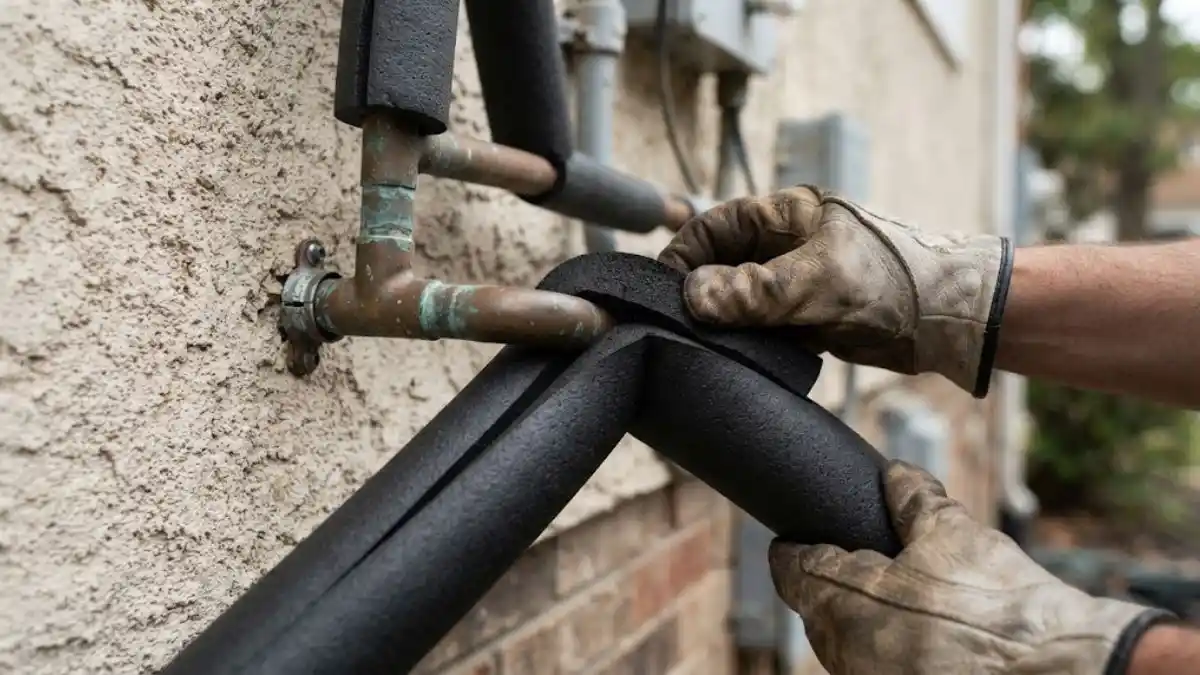
Disconnecting hoses and installing insulated hose bib covers before the first hard freeze prevents a large share of winter burst calls. Pipe insulation sleeves on exposed garage and crawlspace lines cost little compared to an emergency repair.
During the coldest nights, a slow drip from a faucet fed by a vulnerable line keeps water moving through the pipe, which meaningfully reduces freeze risk since moving water resists freezing better than standing water. It is a small step but a genuinely effective one during a hard freeze warning.
If you are leaving Parker during winter for any extended period, keeping the thermostat set no lower than around 55 degrees and having a neighbor check the home periodically protects against a freeze going unnoticed for days, which is often when the worst damage happens, not from the freeze itself but from days of undetected water flow afterward.
A frozen and burst pipe here is often responding to freeze-thaw cycling and expansive clay soil stress at the same time, which is part of why a pipe that broke once in a specific spot is a real candidate to break there again without changes to that section.
Do not use an open flame to thaw a pipe. A hair dryer or heating pad on the frozen section, starting from the end closest to the faucet, is the safer approach, and shutting off the main water supply first prevents a burst from flooding the home if the frozen section has already cracked.
Parker's first hard freeze of the season can arrive earlier than some homeowners expect given the milder stretches that often precede it. Doing an insulation and hose bib check in early fall, rather than waiting for the first cold forecast, avoids a last-minute scramble during an actual freeze warning.
Some crawlspace foundation vents are designed to be closed seasonally to reduce cold air infiltration around plumbing runs during winter. Checking whether your home has this feature and whether the vents are in the correct seasonal position is a small step that is easy to overlook.
A pipe section that survives one freeze-thaw winter without insulation is not necessarily safe long-term, since the same section is also absorbing expansive soil stress year-round. Repeated exposure to both factors over several winters is often what finally causes a failure that looks sudden but was actually years in the making.
Beyond hose bibs, outdoor kitchen plumbing, irrigation backflow preventers, and any exposed fountain or water feature lines need their own winterization step, typically draining and, where applicable, blowing out remaining water with compressed air before the first hard freeze.
Freeze prevention in Parker works best treated as an annual fall routine rather than a one-time home improvement, since insulation degrades, hose bib covers wear out, and new exposed runs sometimes get added during unrelated home projects without anyone thinking to insulate them.
A complete fall check touches every exterior hose bib, all exposed garage and crawlspace lines, the water heater's overall condition heading into the season of highest use, and a quick confirmation that the main shutoff valve still turns freely, since a stuck or corroded shutoff is the worst thing to discover during an actual emergency.
Households that travel regularly during winter benefit from a slightly more conservative approach than the general guidance here, since a freeze that goes undetected for a week does far more damage than one caught the same day. Automated leak detection sensors near vulnerable lines are a reasonable added layer for anyone away from home often during Parker's coldest months.
For hands-on help with this in Castle Rock or the rest of Parker, our Emergency Burst Pipe Repair and Leak Detection teams handle these calls regularly.
Call for a same-day quote.
Serving Parker and every neighborhood in it, plus Centennial, Castle Rock, Highlands Ranch, Castlewood, and Lone Tree.