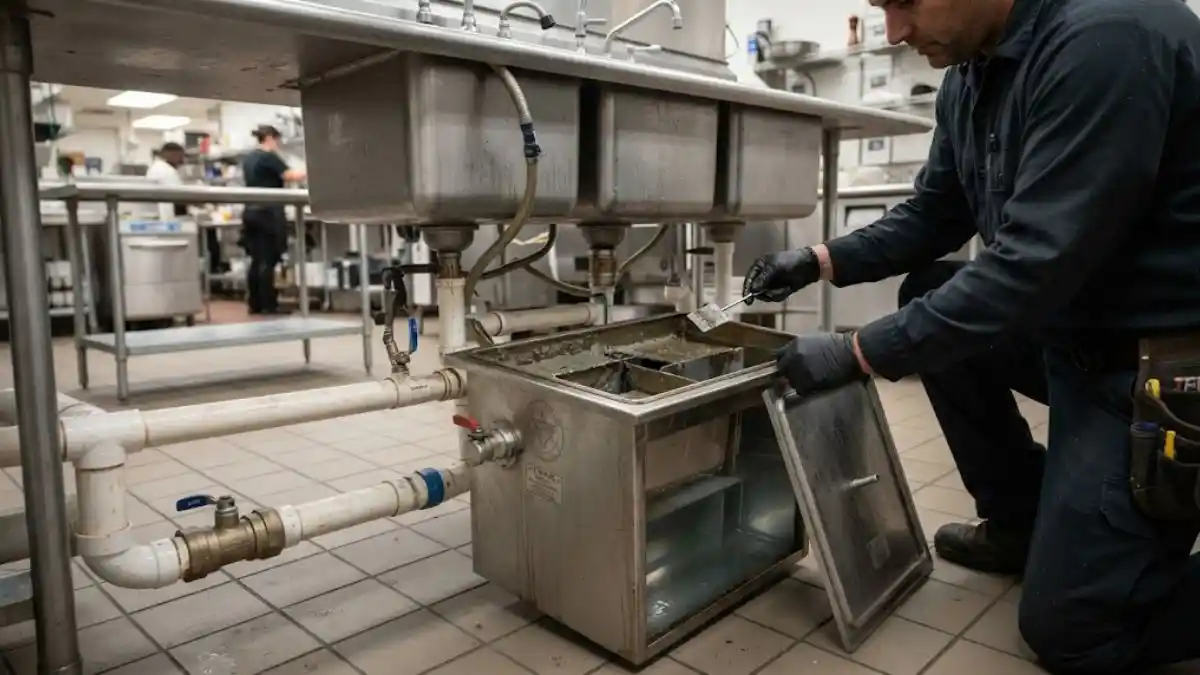
Food-service properties along Parker's commercial corridors carry a compliance responsibility that goes beyond just avoiding a kitchen backup, grease trap cleaning is typically a documented, scheduled requirement, not an as-needed task.
Food-service properties along Parker's commercial corridors carry a compliance responsibility that goes beyond just avoiding a kitchen backup, grease trap cleaning is typically a documented, scheduled requirement, not an as-needed task.
Most local food-service codes require grease trap cleaning on a set interval, generally every one to three months depending on trap size and kitchen volume. Waiting until a backup happens usually means the trap was already overdue.
A trap sized too small for a kitchen's actual grease output needs more frequent cleaning to stay compliant and functional, while an appropriately sized trap for the kitchen's volume can extend the interval between services. If your current schedule feels like it is never enough, the trap size itself, not just the cleaning frequency, is worth reviewing.
Beyond confirming the trap is clean, inspectors typically want to see documented service records showing dates, the servicing company, and disposal method. A trap that looks clean but has no paper trail can still result in a compliance finding if records are what the inspection is actually checking.
A grease trap backup during peak service hours is the most disruptive and most preventable outcome of a missed cleaning schedule, both from a lost-revenue standpoint and a compliance standpoint if an inspection follows.
Compliance generally requires service records showing cleaning dates and disposal method, which is worth keeping on file in case of a health department inspection or a lease requirement from a commercial landlord.
Parker's commercial development along Parker Road has expanded significantly alongside the town's residential growth, and that includes a real, if comparatively smaller, base of food-service demand relative to denser Denver-metro commercial cores. As more restaurants open along the corridor, consistent compliance becomes more relevant to landlords and shopping center management overseeing multiple tenants.
A recurring service arrangement, sized to your kitchen's actual grease volume rather than a generic interval, tends to cost less per visit than reactive emergency service and keeps the compliance paperwork consistent.
A standard cleaning involves pumping out the accumulated grease and solids, wiping down interior surfaces, and inspecting the baffles and inlet and outlet fittings for wear, followed by proper disposal of the waste according to local requirements and issuance of a dated service record for your files.
Scheduling service during off-peak hours, typically mid-morning or mid-afternoon between meal rushes, keeps the disruption to kitchen operations minimal. Most commercial accounts settle into a recurring time slot that works around their specific service hours after the first visit or two.
If you are opening a new food-service location along Parker Road, confirming grease trap sizing and an initial cleaning schedule during buildout, rather than after opening, avoids a compliance gap in the critical early weeks when a health department inspection is often most likely.
The most frequent problems we see are traps sized for the original tenant's kitchen use left unchanged after a new restaurant with heavier grease output moves in, and service intervals that were never adjusted after a menu change increased fryer or grill volume. Both are avoidable with a periodic capacity review rather than a fixed, never-revisited schedule.
In multi-tenant commercial buildings along the corridor, grease trap responsibility sometimes sits with property management rather than individual tenants, or is shared across a common line. Clarifying who is responsible for what before an issue arises avoids a dispute happening at the same time as an active backup.
Grease trap compliance is one of the few plumbing responsibilities that rewards consistency far more than reaction, a kitchen that keeps its schedule rarely thinks about its trap at all, while one that lets service slip tends to end up dealing with both a backup and a compliance conversation at the same time.
Confirming exactly what is included in a cleaning visit, how disposal is documented, and how the provider handles an unexpected backup between scheduled visits are reasonable questions before committing to a service contract, since the answers vary meaningfully between providers.
The cost of consistent scheduled service is small and predictable compared to the combined cost of an emergency backup during business hours, a failed inspection, and the reputational hit of either happening in front of customers, which is the real financial argument for treating this as a fixed operating cost rather than a discretionary expense.
For hands-on help with this in Lone Tree or the rest of Parker, our Grease Trap Cleaning and Commercial Plumbing teams handle these calls regularly.
Call for a same-day quote.
Serving Parker and every neighborhood in it, plus Centennial, Castle Rock, Highlands Ranch, Castlewood, and Lone Tree.