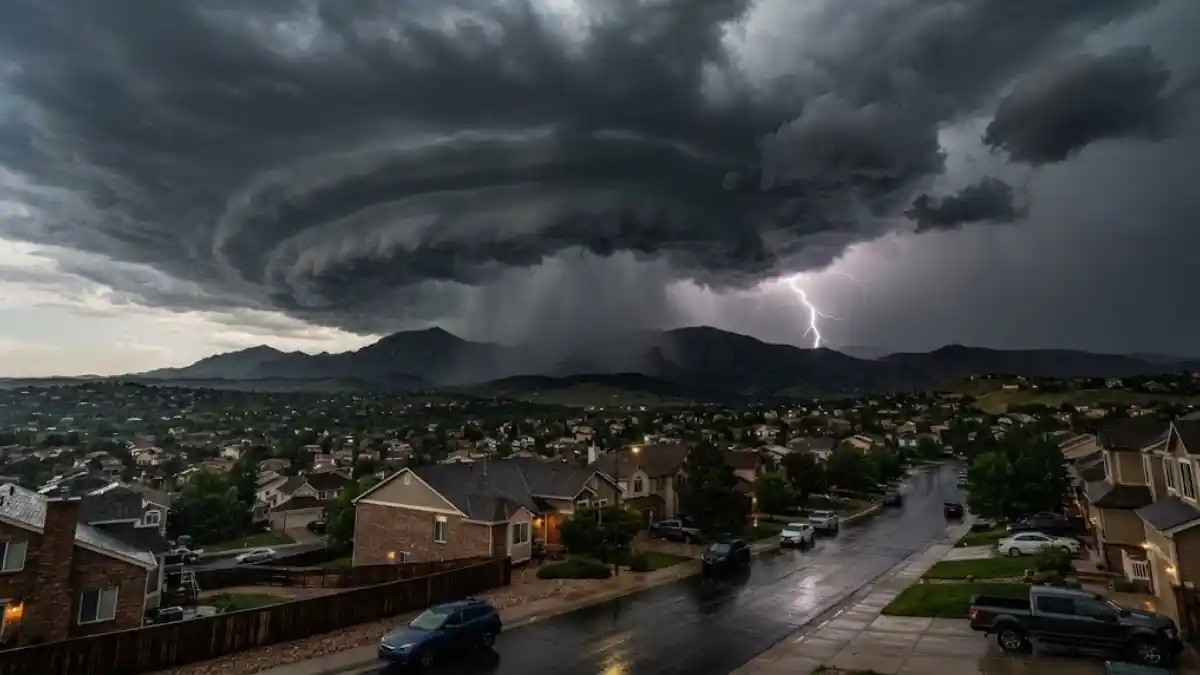
Parker sits inside what the National Weather Service documents as the Palmer Divide hail corridor, a band running roughly from Castle Rock through Parker to Elizabeth that sees some of the highest large-hail report density per square mile in Colorado. That same storm pattern brings flash-flood-level rainfall, and it matters directly for basement flood risk.
Parker sits inside what the National Weather Service documents as the Palmer Divide hail corridor, a band running roughly from Castle Rock through Parker to Elizabeth that sees some of the highest large-hail report density per square mile in Colorado. That same storm pattern brings flash-flood-level rainfall, and it matters directly for basement flood risk.
The Palmer Divide is a topographic ridge that interacts with Front Range weather systems in a way that concentrates severe convective activity. That is the technical reason Parker sees more large hail and more intense short-duration rainfall than towns just a few miles off the ridge.
A storm dropping an inch or more of rain in under an hour puts real pressure on stormwater systems, especially in Parker subdivisions built during the 1990s and 2000s growth boom, before some current stormwater standards were in place. Cherry Creek and its tributary Sulphur Gulch can carry more water than their channels were designed for during these events.
NWS storm reports for this corridor consistently rank it among the highest in the state for large hail frequency per square mile, a pattern distinct enough that meteorologists refer to it by name rather than folding it into general Front Range severe weather. That distinction matters because it means Parker's storm exposure is not just typical Colorado weather, it is a documented regional signature.
Standard homeowner policies generally cover sudden water damage from a storm-related cause, but coverage details vary by policy and by whether water entered through a covered opening versus rising groundwater. It is worth reviewing your specific policy language before storm season rather than during an active claim.
Subdivisions developed earliest in Parker's growth, generally those built closer to the historic Mainstreet core and in some of the first 1990s expansion areas, are more likely to have drainage systems that predate the stormwater standards used in later development. If you are unsure how your neighborhood's infrastructure was built, a local plumber familiar with the area's development history can usually tell you what to expect.
A basement that has never flooded before can still be at risk during a genuinely severe Palmer Divide storm, particularly if the home sits in one of the older subdivisions with dated drainage infrastructure. A tested sump pump with battery backup is the most direct protection against this specific risk.
The corridor's severe season runs roughly May through September, with hail and flash flood risk peaking in that window. Testing a sump pump and checking grade slope away from the foundation before that window opens each year is worth the hour it takes.
This piece focuses on flood risk, but the same corridor that drives flash-flood risk is more famous locally for roof and vehicle hail damage, and homeowners dealing with a hail claim on the roof should also check the basement afterward, since the same storm may have also tested the drainage system.
Ground that slopes away from the foundation for at least the first several feet directs surface water away from the home before it ever reaches a window well or foundation crack. Reversed or flat grading near the foundation, sometimes the result of years of landscaping changes, is one of the most fixable contributors to basement water intrusion during a heavy storm.
A plumber unfamiliar with Parker's specific storm pattern might treat a basement water call as a generic plumbing issue. Understanding that the same storm driving a burst pipe call across town might also be pushing water through a dozen foundation cracks helps prioritize dispatch and diagnosis correctly during an active severe weather event.
Denver proper and many of its immediate suburbs sit outside the Palmer Divide's most intense hail-density band, which means storm severity assumptions built around a general Denver-metro reputation can understate what Parker, Castle Rock, and Elizabeth specifically experience during peak season. Treating the corridor as its own distinct risk zone, rather than folding it into general Denver-area weather, leads to better-prepared homes.
Late April, just ahead of the May start of peak season, is a practical time to run through sump pump testing, grading checks, and window well inspection in one pass, so the home enters the highest-risk months already checked rather than reacting to the first serious storm of the year.
A home that has done the basic preparation, tested sump pump, correct grading, clear window well drains, and a battery backup in place, comes through even a severe Palmer Divide event in far better shape than one relying on luck. None of these steps are expensive individually, the value comes from doing all of them together before the season starts.
For hands-on help with this in Highlands Ranch or the rest of Parker, our Emergency Sump Pump Repair and Emergency Water Damage Restoration teams handle these calls regularly.
Call for a same-day quote.
Serving Parker and every neighborhood in it, plus Centennial, Castle Rock, Highlands Ranch, Castlewood, and Lone Tree.