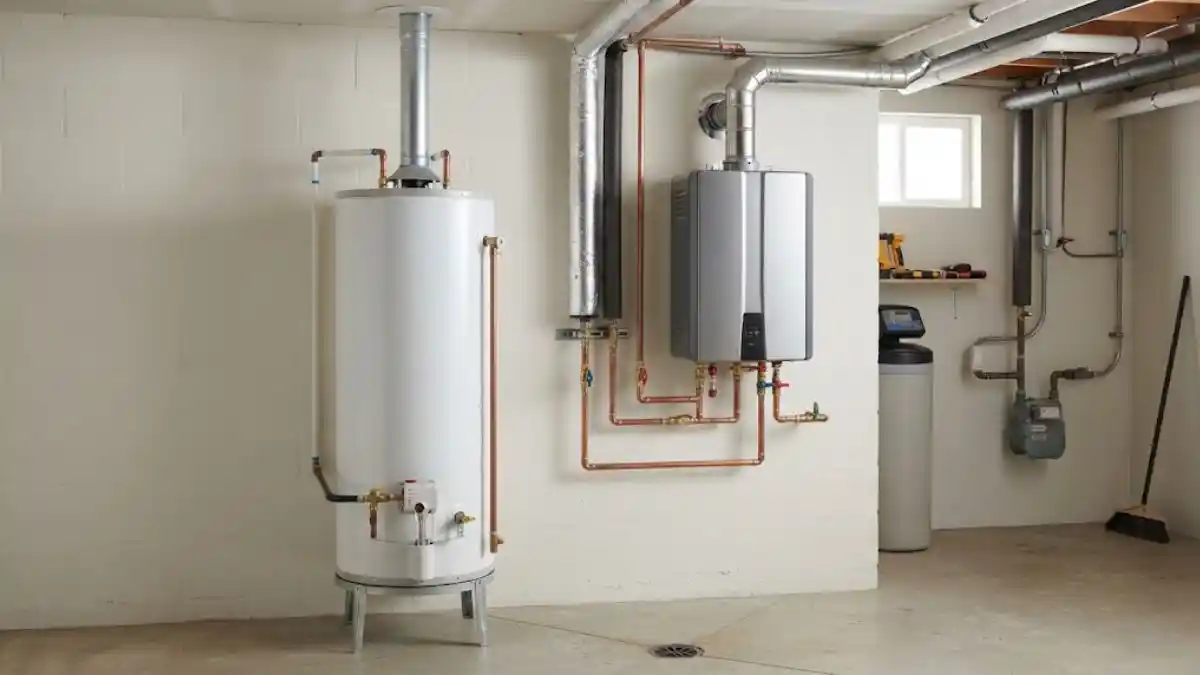
The tank versus tankless decision usually comes down to upfront cost and hot water demand. In Parker, water hardness deserves a place in that conversation too.
The tank versus tankless decision usually comes down to upfront cost and hot water demand. In Parker, water hardness deserves a place in that conversation too.
A tank water heater accumulates sediment at the bottom, gradually losing efficiency and eventually needing replacement. A tankless unit does not accumulate sediment the same way, but hard water can still scale the heat exchanger over time without periodic descaling maintenance.
Tank units need an annual flush to manage sediment. Tankless units need periodic descaling, typically using a vinegar or descaling solution flush through the system. Neither is maintenance-free in a hard-water market, but tankless maintenance is generally less frequent.
A tank replacement typically costs less installed than a tankless conversion, largely because tank units use existing venting and connection points in most cases. Tankless installation can require new venting, a larger gas line, or electrical upgrades depending on the model, which adds to the initial project cost even before the unit itself is factored in.
A tank unit needs floor space in a utility closet, garage, or basement, roughly the footprint of a large trash can. A tankless unit mounts on a wall and takes up a fraction of that space, which matters in Parker's newer homes where utility closets are often sized tightly.
A well-maintained tank in Parker's water conditions realistically runs 10 to 12 years. A well-maintained tankless unit can run 20 years or more, which changes the long-run math even though the upfront installation cost is higher.
Run the numbers over the realistic lifespan of each option rather than just the sticker price. A tankless unit installed today, maintained on schedule, is likely to still be running when a comparable tank installed at the same time has already needed one or two replacements. For some households that math justifies the higher upfront cost, for others the lower initial price of a tank fits the budget better even with a shorter service life.
A smaller household with modest hot water demand and a tighter upfront budget often does fine with a tank, especially if flushing happens on schedule. A larger household, or anyone tired of running out of hot water, tends to get more long-run value from tankless despite the higher install cost.
Whichever unit you choose, pairing it with a whole-home filtration or softening system reduces the mineral load reaching the unit in the first place, which extends maintenance intervals and protects the investment either way. It is worth pricing as part of the same project rather than a separate future decision.
Tankless units and high-efficiency tank models sometimes qualify for utility rebates, which can offset part of the higher upfront cost of going tankless. It is worth asking about current rebate programs when getting a quote, since availability changes periodically.
If you are still unsure, think through how often your household currently runs out of hot water and how long you plan to stay in the home. Frequent hot water shortages point toward tankless, while a shorter expected time in the home may not justify the higher upfront tankless cost even with the better long-run numbers.
Because the two options have such different installation requirements, a fair comparison needs actual quotes for both, not a rough estimate for one and a guess for the other. Venting and gas line requirements specific to your home can shift the tankless number meaningfully, which is worth knowing before deciding based on general pricing you have seen online.
Converting from tank to tankless typically involves removing the old tank, installing new venting rated for the tankless unit, and in some cases upgrading the gas line to handle the higher instantaneous demand tankless units require. This is why a straightforward tank-to-tank swap can often happen same day while a tankless conversion sometimes needs a follow-up visit.
Both options are legitimate choices for a Parker home when properly sized, installed, and maintained for the local water conditions, the right one depends on your specific budget, household size, and how long you plan to own the home, not on one option being objectively superior in every case.
If the upfront cost difference is the main hesitation, running the numbers over a 15-year horizon rather than comparing sticker prices alone usually clarifies things, since that timeframe is long enough for a tank's likely replacement to factor into the comparison.
For hands-on help with this in Castle Rock or the rest of Parker, our Water Heater Installation and Water Filtration System Installation teams handle these calls regularly.
Call for a same-day quote.
Serving Parker and every neighborhood in it, plus Centennial, Castle Rock, Highlands Ranch, Castlewood, and Lone Tree.