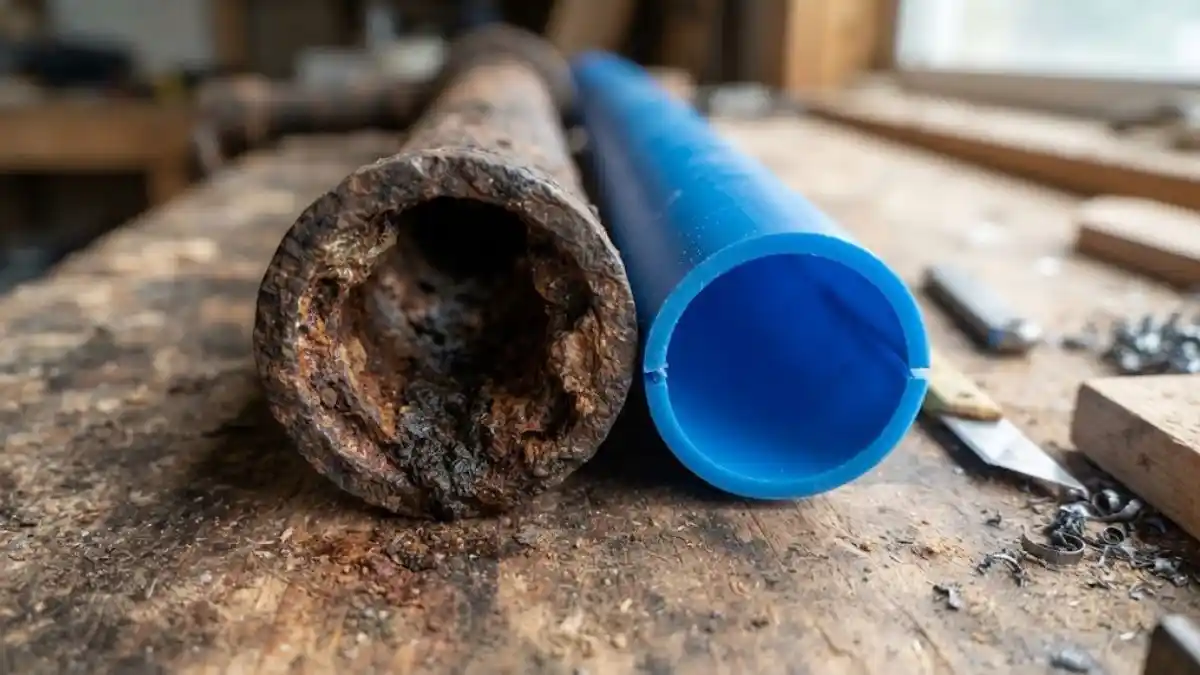
Homes near Parker's historic Mainstreet corridor predate the town's major growth years, and some still carry original galvanized supply lines well past their realistic service life.
Homes near Parker's historic Mainstreet corridor predate the town's major growth years, and some still carry original galvanized supply lines well past their realistic service life.
Galvanized steel pipe corrodes from the inside out, gradually restricting flow as rust builds up along the interior wall. Combined with Parker's hard water accelerating that internal buildup, homes with original galvanized lines often show pressure and discoloration issues that trace directly back to the pipe material itself.
Multiple pinhole leaks in different, unrelated locations point to the pipe material failing broadly rather than one bad section. The same goes for pressure that is low at every fixture in the home rather than just one.
Galvanized supply piping is a common flag on inspection reports for Parker's older original-townsite homes, sometimes surprising buyers who assumed a home's plumbing was updated along with visible renovations.
When replacing galvanized pipe, both copper and PEX are code-compliant choices, but they behave differently. Copper has a longer track record and slightly better heat tolerance, while PEX resists the mineral scale buildup that comes with Parker's hard water somewhat better and typically costs less installed. Neither choice is wrong, the decision usually comes down to budget and the specific configuration of the home.
A repipe is a larger upfront investment than most plumbing repairs, but it replaces a recurring cost, the pinhole leak repairs, water damage cleanup, and pressure complaints that an aging galvanized system tends to generate over time, with a single project that resolves the underlying cause.
A repipe does not have to mean opening every wall. Planning the new run room by room, and choosing PEX where it fits the situation, keeps the home more livable during the work and often avoids some of the access points a less-planned approach would require.
Because the work happens in phases, it is possible to plan a repipe around a period when the household can tolerate brief water interruptions, rather than treating it as an all-at-once disruption. A contractor familiar with occupied-home repipes can usually work with your schedule rather than the other way around.
Depending on access, some repipe work is possible through unfinished spaces like a basement or crawlspace with minimal wall opening, while other runs do require limited drywall access that gets patched afterward. A clear walkthrough before work starts should tell you exactly which walls, if any, will need patching once plumbing is complete.
If a larger renovation or remodel is already planned for the home, coordinating the repipe to happen during that same project, while walls are already open for other reasons, can reduce total disruption and sometimes total cost compared to doing the two projects separately.
Piecemeal repair of individual leaks in an aging galvanized system treats each failure as isolated, when the underlying cause, the pipe material itself, keeps producing new failures elsewhere. A repipe addresses the actual cause rather than an ongoing series of its symptoms.
For owners of older Mainstreet-area homes considering a future sale, resolving flagged galvanized piping ahead of listing removes a common inspection negotiation point entirely, rather than facing a price reduction or repair credit request during a transaction where the buyer holds the stronger negotiating position.
A thorough pre-repipe walkthrough should identify every fixture the new system will serve, note any known problem areas from past repairs, and give you a written scope before work starts, so there is no ambiguity about what is and is not included once the project is underway.
Galvanized pipe does not improve with age, and each additional pinhole leak or pressure complaint is evidence the underlying material is continuing to fail rather than stabilizing. Homeowners who wait for one more leak before deciding often find themselves making the same decision eventually, just after more accumulated repair cost.
A clear diagnosis, an honest cost comparison against continued piecemeal repairs, and a realistic timeline are usually enough for most homeowners to decide with confidence, rather than continuing to defer a decision that tends to become more urgent, not less, with each additional leak.
For anyone planning to stay in a Mainstreet-area home for many more years, a repipe is one of the few plumbing projects that genuinely resets the clock on future pipe-related repairs, rather than simply addressing the most recent symptom of an aging system.
For hands-on help with this in Castle Rock or the rest of Parker, our Whole House Repipe and Leak Detection teams handle these calls regularly.
Call for a same-day quote.
Serving Parker and every neighborhood in it, plus Centennial, Castle Rock, Highlands Ranch, Castlewood, and Lone Tree.